


For the past few years, the binding constraint on hyperscale development has been speed to power. After Tuesday’s election results, it is also speed to social license to operate. Data centers were on the ballot, and voters were clear: These facilities should pay their own way, and in some communities, they are not welcome at all. The election results signal a fundamental shift in how digital infrastructure will be sited, powered, and permitted across the United States.
The results that matter
Because retail electric rates, large-load tariffs, siting, and permits are decided mostly by states and localities, the down-ballot results may matter more to developers than the change in control of Congress.
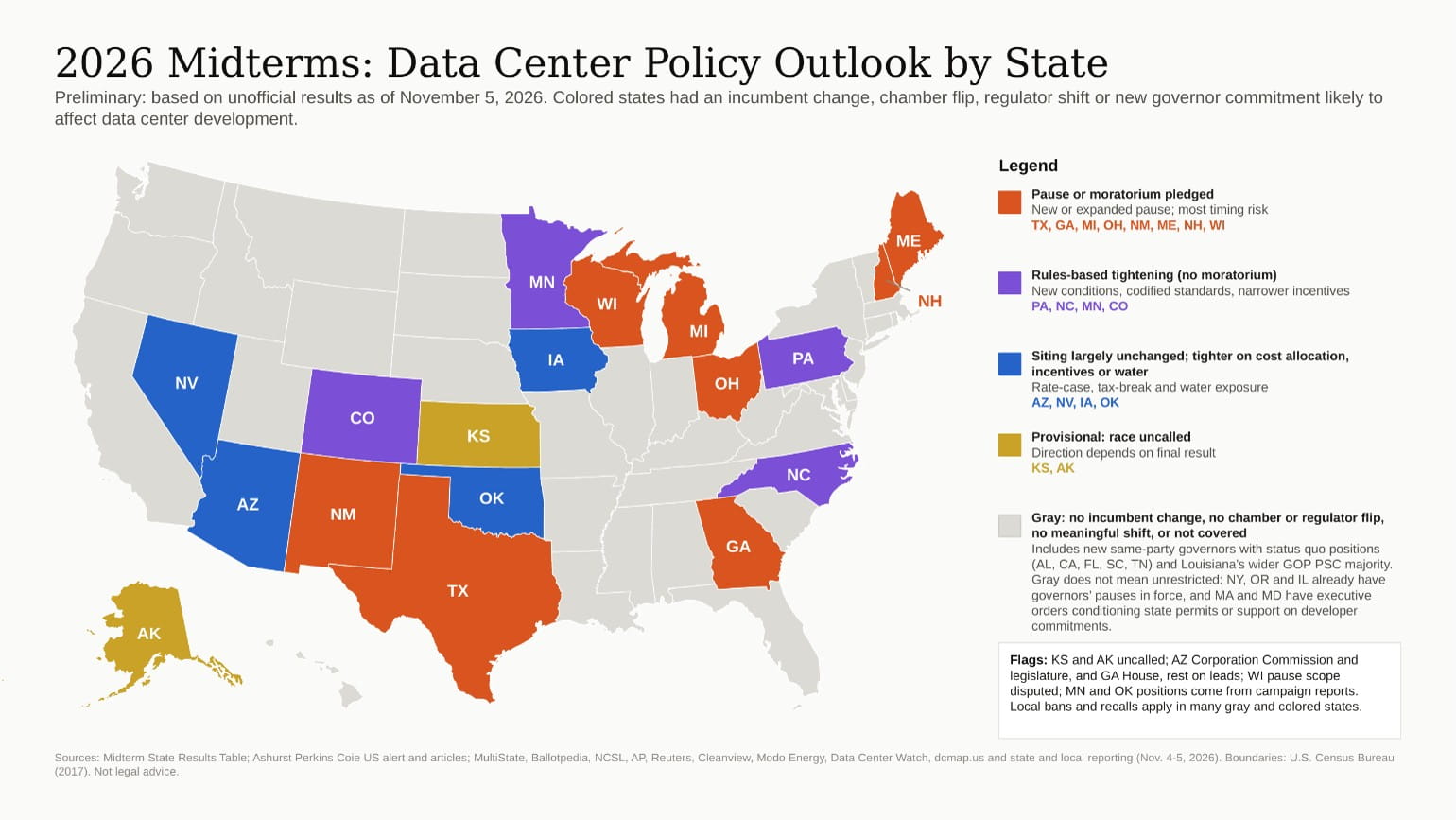
- Texas: Gina Hinojosa unseated Governor Greg Abbott after campaigning for a statewide moratorium on data center approvals until the Texas Legislature adopts new guidelines; she has said the pause would apply to proposed projects, and reports indicate currently permitted projects would be allowed to complete construction. Democrats are also on track to control the Texas House for the first time in 24 years, while the state Senate appears to remain Republican. Texas accounts for roughly a quarter of planned U.S. data center capacity.
- Georgia: Democrats won both Public Service Commission seats on the ballot, giving them a majority on the commission that regulates Georgia Power for the first time since 1995. Democrat Keisha Lance Bottoms won the governor’s race; before the vote, she pledged a statewide moratorium on new data center construction.
- Other governors: Iowa’s Rob Sand ran on making data centers cover their own grid costs, ending tax breaks and blocking nondisclosure agreements. Nevada’s Aaron Ford, who unseated Governor Joe Lombardo, opposes data center development on federal land.
- Louisiana: Republicans won both open Public Service Commission seats, widening their majority to two seats. District 5 is a hotspot for new data center development.
- Local ballot measures: Voters in 10 states decided 41 local data center measures, 21 of them in Ohio. Every one of the 32 measures with reported results went in favor of limits. Pataskala and Granville, Ohio, approved bans on facilities above 25 MW with 74% and 82% of the vote, and four Illinois townships voted against future data center development.
- Potential pauses or moratoriums: Governors or governors-elect in Texas, Georgia, Michigan, Ohio, New Mexico, Wisconsin, Maine, and New Hampshire have promised pauses. Pledges are open-ended, time-limited, or conditional, and most need a legislative or regulatory vehicle but should be treated as real risk.
- Congress: Democrats won both chambers. As of November 9, 2026, they held 54 Senate seats (including two independents) to 44, with two races uncalled. The new majorities take over in January 2027; the president keeps his veto.
Key takeaways for developers and investors
- Re-underwrite entitlement risk now: Map pending permits, tariff proceedings, and incentive agreements in affected states; seek vested-rights and grandfathering protection, longer purchase sale agreement (PSA) contingencies, and moratorium off-ramps.
- Lead with ratepayer protection: Offer minimum-take, collateral, and exit-fee terms and fund upgrades before regulators require them, and draft agreements to absorb later regulatory change.
- Structure with clean energy resources and grid resilience in mind: FERC-led reforms to large load grid connection processes are rolling out in regional markets across the nation. Mastering these new processes, which are designed to connect loads faster without adverse impact on reliability or other ratepayers, remains crucial. There will also be a heightened interest in on-site generation, including islanded capability and dedicated renewable or nuclear supply to insulate projects from interconnection delays and respond to new clean energy mandates. Off-grid generation is expensive and tricky to contract and finance, though, so developers need to carefully plan and structure these projects.
- Build for community consent: Drop NDAs, make binding water commitments, and sign community benefit agreements, such as investments in water recycling or grid resilience, before the first permit application. Keep engagement local but with an eye to national coordination of litigation strategies as opposition manifests across jurisdictions.
- Focus on areas of growing consensus, like permitting reform: The U.S. Senate may hold procedural votes as early as November 9 on the Bipartisan American Affordability and Jobs Act (S. 5653), which would require environmental impact statements within two years, limit legal challenges to 150 days after approval, bar agencies from revoking permits, and require data center developers to pay the electricity costs of running their facilities. The bill pairs faster permitting and judicial review with data centers paying their transmission costs, and the incoming Senate class is likely to add cost-allocation, ratepayer, and community conditions. While passage remains uncertain in the lame-duck session, there is an opportunity to push forward reform that can facilitate responsible data center development.
- Engage before January: Participate in the permitting debate and in state transition planning. Commission appointments, legislative agendas, and utility proceedings will be set in the next 60 to 90 days, and developers who show up with credible cost-allocation proposals will shape the outcome.


