


Democrats made broad gains nationally on November 3, 2026. For many of the Democratic winners, a key campaign talking point was a commitment to limit or restrict future data center development. Our earlier alert, “Key takeaways for data center developers from the 2026 midterm elections” addressed the national picture. This Legal Development focuses on Texas, where the change in state leadership is likely to have the most immediate consequences for projects already in the pipeline.
Developers should prepare for the following:
- Utility costs and affordability are likely to drive policy, and Democrats have an opening to act on voter frustration over energy costs.
- Governor-elect Gina Hinojosa may inherit ERCOT's pause on energizing new large-load data centers and its delayed Batch Zero classifications and study. TCEQ has stated it has resumed normal permit review. The ambitious platform she has proposed is likely to result in a broader halt soon after inauguration. Her stated scope covers all state permits, including for projects already underway, although the legal mechanism, start date, and duration have not been defined.
- Developers should prepare for slower and more searching permit review, even if a formal moratorium does not come to pass.
- Grandfathering terms will likely decide which projects go forward, so priority goes to securing power, permits, and site work now. In Texas, the key questions include whether sufficiently complete local permit applications establish vested rights, how the PUCT’s large-load rule applies to projects that had not energized by October 8, 2026, and how 2027 legislation may affect projects already in ERCOT’s Batch Zero study.
- Tax exemptions and abatements are at risk, and in Texas, support for repeal crosses party lines; project economics should be tested without them.
- As community opposition to data centers accelerates statewide, binding commitments on water, local investment, and transparency, including limits on nondisclosure agreements (NDAs), increasingly decide whether projects move forward.
Current state of play: Texas data center directives and key dates.
Between June and September 2026, Governor Greg Abbott issued four executive directives affecting data center development. On June 10, Abbott directed the Public Utility Commission of Texas (PUCT) to pursue measures to protect residential ratepayers from data-center-related infrastructure costs, including requiring data centers to pay costs attributable to their electric infrastructure, and directed the PUCT and the Electric Reliability Council of Texas (ERCOT) to review their existing authority. On August 3, he directed the PUCT and ERCOT to audit all data centers advancing through ERCOT's interconnection process, requiring information on public financial assistance; power consumption and on-site generation; water consumption, sources, and cooling technology; noise, light, and traffic impacts; and ownership and control. The directive states that any project that fails to comply with PUCT and ERCOT requirements must be denied connection to the grid. For loads of 75 MW or more, the audit overlays ERCOT’s “Batch Zero” process, a one-time, system-wide study under rules the PUCT approved in June that classifies qualifying large-load requests as base load, studied load, or excluded load. ERCOT issued provisional, conditional classifications on September 3, 2026, subject to verification and other conditions. The audit and verification process has affected the timing of Batch Zero classifications and study completion.1
On September 14, Abbott directed the Texas Water Development Board (TWDB) to enforce water-use reporting requirements. Noncompliance may result in referral for criminal prosecution and disqualification from obtaining, amending, or renewing Texas Commission on Environmental Quality (TCEQ) water-rights permits under Chapter 11 of the Texas Water Code.
On September 21, Abbott directed TCEQ to halt all permits sought by data centers and pause issuance of all permits related to data center projects until ERCOT completes its review. He further directed that no other state agency move forward with regulatory approvals related to data centers until the PUCT, ERCOT, and TWDB information is acquired.
In its October 19 compliance update, TCEQ reported that it had paused issuance of all permits related to the construction or development of infrastructure directly supporting data centers, was screening pending applications, and, where possible, was suspending claimed authorizations. TCEQ temporarily shut down its STEERS e-filing portal so that agency staff could review all applications to determine whether they were related to data centers. The STEERS system has now reopened for construction, multi-sector, and concrete production general permits. According to press reports, TCEQ received notice from the governor’s office on November 13 that ERCOT had completed gathering information on potential community impacts from data centers and started normal permit review. On November 16, 2026, TCEQ reportedly issued an air authorization for a gas-fired plant serving planned data centers.
Impact of Texas results on data center development
In the midterm election, Democrat Gina Hinojosa defeated incumbent Governor Greg Abbott, becoming the first Democratic governor of Texas in more than three decades. Democrat Vikki Goodwin defeated Lieutenant Governor Dan Patrick, and Democrats won every statewide office on the ballot, including attorney general. Democrats will control the Texas House, while Republicans retain a majority in the Senate. During her campaign, Hinojosa announced a six-point platform for the next legislative session.
Governor-Elect Hinojosa’s “Texans First Data Center Priorities”
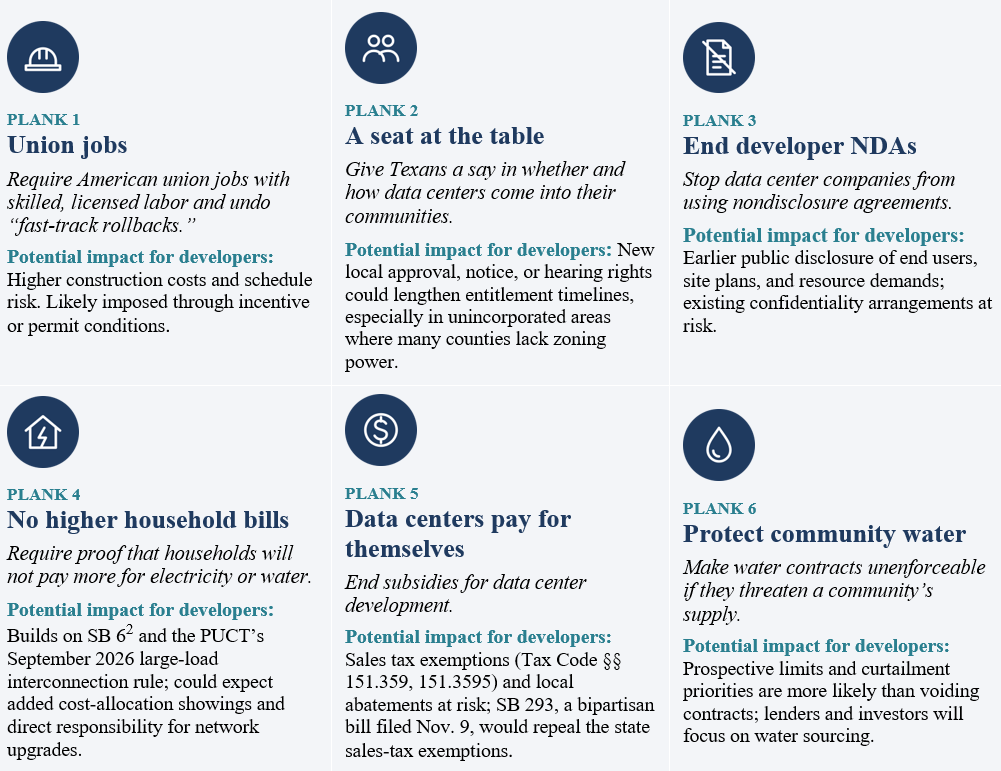
Status as of November 19, 2026. Planks are campaign proposals; none has been enacted.
On October 22, 2026, Hinojosa stated that, as governor, she would issue a moratorium on all data center approvals until the legislature could pass laws to protect Texans. In an interview published after the election, she said the moratorium would be “for all permits” and that an already-permitted project that still needs a state permit would be “on hold.” She has not yet said when her moratorium would start or what legal mechanism she would use to impose it. Execution of Hinojosa’s ambitious platform will turn on the legislature. Although Democrats will control the House and Lieutenant Governor-elect Goodwin will preside over the Senate, Republicans will retain a majority in the Senate and could seek to change Senate rules affecting the lieutenant governor’s authority.
Although a Texas governor lacks clear statutory authority to impose a binding statewide moratorium on lawful private development, Hinojosa still has practical leverage. She can set executive-branch priorities for agencies such as the TCEQ, make appointments as terms expire and vacancies arise (subject to applicable confirmation requirements), call special sessions, designate data center bills as emergency items for consideration in the first 60 days of session, and exercise veto and line-item veto authority. Any near-term pause would more likely be attempted through agency directives or exercises of existing permitting authority, with legislation potentially providing a more durable framework.
Impacts on communities
Both parties have raised concerns about data center impacts, with ratepayer protection, water security, and transparency receiving the most attention. Hinojosa’s call for local input; the audit’s focus on water, noise, light and traffic impacts; Brownsville’s enacted 90-day moratorium; and the pending processes in Fort Worth and Denton all point to heightened scrutiny. Projects that make credible, enforceable commitments will be better positioned to advance.
What Texas developers should do now
Map each project against each applicable review or pause: Sort projects by ERCOT large-load status and grid connection, and list every pending TCEQ air and water authorization, including on-site and backup generation. Grid-connected co-located projects still face audit disclosure and the PUCT’s SB 6 rules.
Close water gaps: Return TWDB surveys and confirm water supply and curtailment terms.
Use the window before January 19: Evaluate whether sufficiently complete local permit applications can establish vested rights under Chapter 245 before a change in law. Even though filing before the transition does not guarantee protections and vesting does not bind TCEQ, PUCT, or other state agencies, it is advisable to engage now with the Hinojosa transition and with legislators before agency appointments are made.
Review contracts and financing: Check change-in-law, force majeure, outside-date, and termination terms in leases, power, engineering, procurement, and construction, and equipment contracts, and allocate this now-foreseeable risk expressly in new contracts. Get ahead of expected cost-allocation showings by offering ratepayer protections such as minimum-take commitments, collateral, and exit fees.
Lead with community benefits: Before the first permit application, replace NDAs with transparent, appropriately tailored confidentiality provisions, make enforceable water commitments, and sign community benefit agreements, such as investments in water recycling or grid resilience. In Texas, this may be particularly important in cities considering moratoriums and in unincorporated areas, where most counties lack broad general zoning authority (though statutory exceptions exist).
Looking ahead
Following the midterms, the data center market in Texas faces its most significant policy uncertainty to date. Many details will turn on the incoming administration’s first executive actions and how any proposed moratorium treats projects already in progress. We will continue to monitor the transition and the 2027 legislative session and will provide updates as specifics emerge.
Endnotes
-
ERCOT will file its verification and community impact reports for the data centers in the queue on December 10, which will determine which facilities “passed” the audit. While April 9, 2027, remains the existing deadline for study results, ERCOT's general counsel has said the study will not be completed by that date; no new date has been set. See our comment related to Batch Zero here.
-
See our alert, SB 6 Implementation Shaping Data Center Future in Texas, for more details.


