


Key takeaways
- Generative AI (GenAI) is increasingly used to create visual assets in video games, creating opportunities for efficiency and innovation while raising key questions about copyright protection and registration.
- The U.S. Copyright Office maintains that copyright protection requires human authorship; an AI-assisted work may qualify for protection when a human contributes sufficient original expression.
- Invoke’s registration for A Single Piece of American Cheese highlights how human creative contributions may support copyright protection for an AI-assisted work, even when individual elements were AI-generated.
- Game developers using GenAI tools should maintain detailed records of human contributions, consider registration for important visual assets, and review platforms’ disclosure requirements.
The video game industry is being transformed by the integration of generative AI into creative workflows. AI-generated characters, environments, and other visual assets are becoming increasingly common, offering new possibilities for innovation, but also raising complex questions about copyright ownership of these assets.
This article examines the current state of copyright law as it applies to AI-generated content and provides strategic guidance for game developers navigating this evolving intersection of technology and copyright law.
How is generative AI transforming video games?
The adoption of AI-generated visuals in video games has accelerated dramatically in recent years. A 2023 survey of more than 3,000 game developers of various sizes revealed that 49% of these developers used GenAI tools in their workplace, with 21% of surveyed game designers and 16% of surveyed visual artists reporting using such tools. [1] Furthermore, as of July 2025, nearly 8,000 games on Steam disclose the use of GenAI tools, and about 60% of those disclosures mention these tools were used for visual asset generation. [2]
Based on these statistics, it is likely that a significant portion of visual assets in recently developed games have been created by GenAI. This trend is no surprise, as GenAI tools can help speed up development timelines and reduce labor costs, especially in large and/or visually complex games requiring many different visual elements to be developed. However, the use of these tools also raises legal uncertainties regarding the ownership of visual assets, which should be carefully considered.
Can AI-generated visual works receive copyright protection?
The United States Copyright Office has consistently maintained that copyright protection can only be granted to works created by human authors. [3] However, this does not mean any visual works generated with the help of an AI tool are automatically ineligible for copyright protection. In scenarios where an AI tool is merely used to assist a human who otherwise contributes original authorship, that individual may still obtain a copyright protection for the work. [4] While the exact line between copyright-eligible human authorship and copyright-ineligible AI-generated works remains unclear, a legal milestone has recently occurred that provides some guidance for game creators considering the use of AI tools for visual asset generation.
In January 2025, a company called Invoke received the first successful copyright registration for a complete image, called A Single Piece of American Cheese, in which each element was generated entirely by AI. [5] This feat was achieved by using a technique called “inpainting,” where a human artist selected an AI-generated image, added features to certain portions of the image manually, and then prompted a GenAI tool to modify those portions of the image to be consistent with surrounding elements (see below). [6]
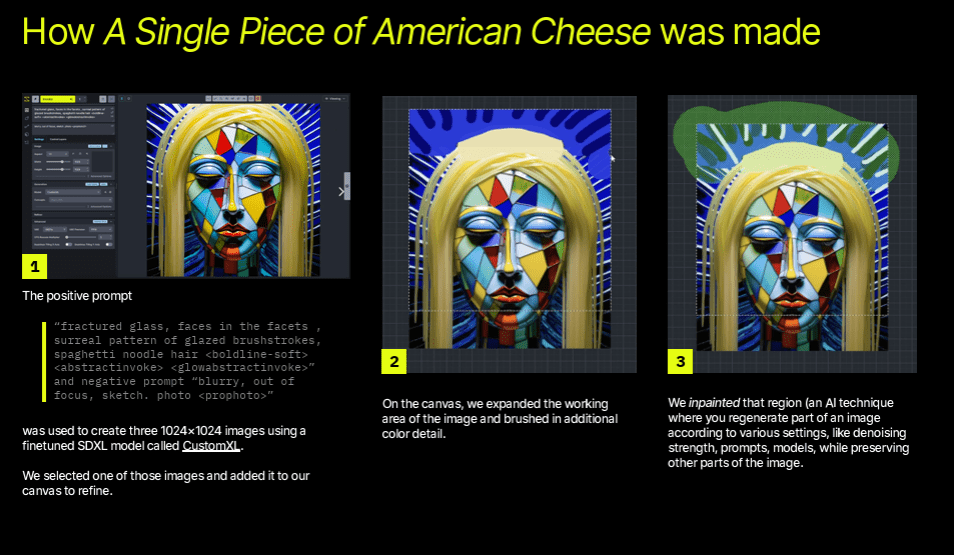
Although the individual visual elements remaining in the final image are therefore all AI-generated, Invoke was still able to register a copyright for the entire image because a human “actively selected, coordinated, and arranged” each element into a final composition. [7] Critically, Invoke was able to provide video evidence of the image’s generation process to the Copyright Office, enabling Invoke to demonstrate the human contributions made to the final product. [8]
What should game developers know about AI and copyright?
Invoke’s successful registration of A Single Piece of American Cheese is a valuable example for gaming industry professionals using GenAI tools to generate in-game visual assets. This example indicates that game developers can and should seek copyright registration for assets that are generated by AI, but for which a human makes creative contributions such as arranging and selecting visual elements.
Although creative works can receive copyright protection even without being formally registered, copyright registration nonetheless provides significant value, creating a presumption of validity and granting copyright owners additional privileges during litigation. [9] Registration is especially valuable given the unsettled nature of copyright law in relation to AI-assisted visual works, as a registered copyright will provide its owner with a clear delineation of the IP rights that they hold, aiding in activities such as enforcement and licensing negotiations.
Importantly, however, the Copyright Office may require evidence of human contributions before granting registration. Thus, whenever visual assets are generated with the aid of AI, it would be in the interest of game developers to keep careful records of the generation process in case evidence of human contributions are later needed for registration.
Copyrightability of AI-generated and AI-assisted works continues to develop in 2026, including through cases such as Thaler v. Perlmutter and Suryast U.S. Enterprises, LLC v. Perlmutter.
What are best practices for game developers using AI?
In light of the evolving nature of the above legal issues, game developers using AI for the creation of in-game visual assets should consider implementing the following best practices:
- Maintain detailed logs of human contributions during the asset generation process.
- Proactively seek copyright registration for important visual assets (e.g., those likely to be used in marketing/licensing).
- Review game platform submission guidelines (e.g., Steam, PlayStation Store) for GenAI disclosure requirements.
Ashurst Perkins Coie’s gaming, media entertainment, and sports lawyers regularly advise game studios on GenAI integration, IP strategy, and regulatory compliance. If you have questions about any of the topics above, please contact us to discuss tailored solutions to your GenAI workflows and asset management needs.
Endnotes
[1] Game Developers, 2024 State of the Game Industry, OR. STATE UNIV. (Game Dev. Conf. Mar. March 18 – 22, 2024 S.F. Cal.), https://web.engr.oregonstate.edu/~mjb/cs557/2024StateOfTheGameIndustry.pdf
[2] Ichiro Lambe, The New Surprising Number of Steam Games that use GenAI, Totally Human Media: Articles (July 13, 2025), https://www.totallyhuman.io/blog/the-surprising-new-number-of-genai-games-on-steam.
[3] Copyright Registration Guidance: Works Containing Material Generated by Artificial Intelligence, 88 Fed. Reg. 16190, 16191 (Mar. 15, 2023) (to be codified 37 C.F.R. pt. 202), https://www.federalregister.gov/documents/2023/03/16/2023-05321/copyright-registration-guidance-works-containing-material-generated-by-artificial-intelligence (“In the Office's view, it is well-established that copyright can protect only material that is the product of human creativity. Most fundamentally, the term “author,” which is used in both the Constitution and the Copyright Act, excludes non-humans.”)
[4] 88 Fed. Reg. at 16192. (“[A] work containing AI-generated material will also contain sufficient human authorship to support a copyright claim. For example, a human may select or arrange AI-generated material in a sufficiently creative way that ‘the resulting work as a whole constitutes an original work of authorship.’”)
[5] Invoke.com, How we Received the First Copyright for a Single Image Created Entirely with AI-Generated Material 11, https://44037860.fs1.hubspotusercontent-na1.net/hubfs/44037860/Invoke-First-Copyright-Image-AI-Generated-Material-Report.pdf
[6] Id.
[7] Id. 13.
[8] Id.
[9] Registration is necessary to sue in federal court and to collect statutory damages/attorneys’ fees in a copyright litigation action. See Copyright Alliance, FAQS, https://copyrightalliance.org/faqs/benefits-of-copyright-registration/ (last visited Oct. 31, 2025).


