First ever final leasing notice: Offshore critical minerals lease sale in American Samoa



On October 20, 2026, the Marine Minerals Administration (MMA)1 published the Final Leasing Notice (FLN) for the first Outer Continental Shelf (OCS) mineral lease sale offshore American Samoa (Lease Sale PACM-1). The FLN is the final regulatory step before the auction and marks a significant acceleration of the administration’s objectives under Executive Order 14285, “Unleashing America’s Offshore Critical Minerals and Resources.” BOEM’s November 2025 Area Identification (Area ID)2 followed the June 2025 Request for Information and Interest (RFI).
The process began with an April 2025 unsolicited lease request. BOEM published an RFI in June 2025 covering about 18.1 million acres bordering the Cook Islands Exclusive Economic Zone (EEZ) and, after receiving more than 76,000 comments, issued an Area ID of about 33.1 million acres on November 10, 2025.
On February 13, 2026, NMFS issued a Letter of Concurrence, finding the action is “not likely to adversely affect” listed species, provided survey equipment does not exceed 160 dB. NMFS later found that revised acoustics descriptions did not require reinitiation but offered to review lessees’ actual equipment settings, so lessees should expect acoustic specifications to be scrutinized in their preliminary activity notices.
MMA then completed an Environmental Assessment (EA) on July 16, 2026, and published the Proposed Leasing Notice (PLN) on July 17, 2026. The Finding of No Significant Impact, signed October 14, 2026, was published along with the FLN, which adopted the PLN’s lease areas, terms, stipulations, and ITLs without substantive change and rejected an option to delay the sale pending collection of more seabed data.
MMA will offer two lease areas, OCS-P 0568 (about 16.3 million acres) and OCS-P 0569 (about 15.2 million acres), lying roughly 130 to 200 nautical miles east of Pago Pago in depths of up to about 20,000 feet, after removing buffer blocks adjoining the Cook Islands EEZ and the Rose Atoll Marine National Monument. OCS-P 0568 is prospective for polymetallic nodules and OCS-P 0569 for both nodules and ferromanganese crusts; leases convey rights to minerals in those deposits, plus incidental minerals.3 MMA acknowledges that sparse mapping data mean resource estimates rely heavily on extrapolation.
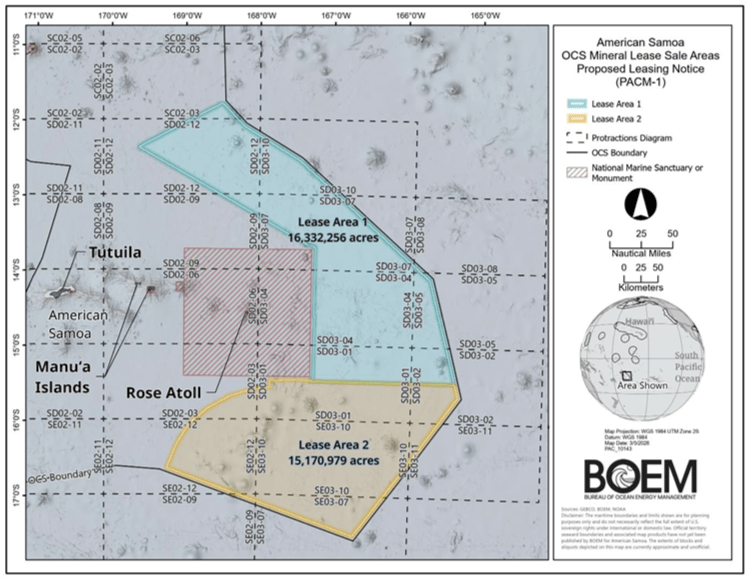
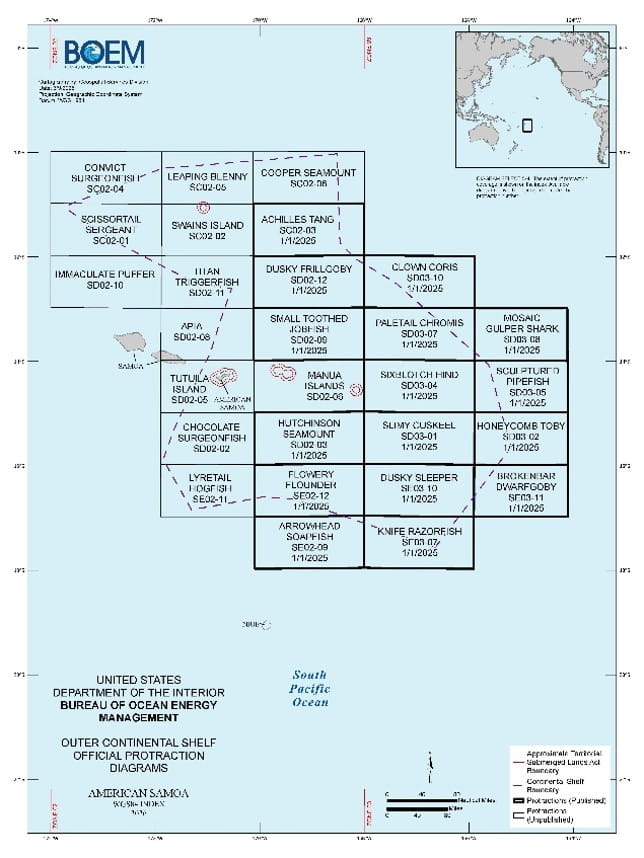
American Samoa official protraction diagrams
MMA concluded in the EA/FONSI that issuing up to two leases authorizing only preliminary activities would not significantly affect the quality of the human environment, so an Environmental Impact Statement (EIS) is not required. Commenters called for a programmatic EIS.
The EA’s findings rest on the limited footprint of preliminary activities: MMA estimated that sampling would disturb only about 2,667 square meters of seabed, with three to six vessels in the lease areas at any one time. The EA excluded dredging and medium-penetration or low-frequency sound sources and dismissed a 25- or 50-nautical-mile buffer around Rose Atoll as unnecessary at this stage. The EA also acknowledges significant data gaps, including that abyssal habitats in the lease areas remain poorly studied, and MMA could not further estimate impacts on marine mammals and sea turtles given limited data on their presence, behavior, and sound transmission in these deep waters.
As discussed in our prior updates,4 the American Samoa government remains unified in opposing leasing and supports the governor’s July 2024 moratorium on seabed mining. In September 2026 comments,5 the governor sought, among other things, a research-focused preliminary period, fisheries and Rose Atoll protections, preservation of future federal consistency review, and revenue sharing. MMA accepted these requests only “to the extent” allowed by law, acknowledged that current law does not authorize revenue sharing (though it noted pending H.R. 10318), and treated the territory’s CZMA concurrence as presumed after 60 days without a response. These positions may see further legal challenges.
The sale will be held on Thursday, November 19, 2026, and livestreamed for public viewing. A single bidder may win both areas. Key requirements include:
MMA treats the competitive auction itself as assurance of fair market value, so winning bids will not face a separate valuation review.
Leases carry a 20-year primary term, continuing while minerals are produced under an approved mining plan, and a $3,000,000 minimum bonus bid per lease area. Rather than mandating relinquishment, MMA uses escalating rent to encourage lessees to shed acreage (targeting 50% by year six and about 15% by year 11). No rent is due in years zero through five; rent then rises in tiers from $0.30–$1.20 per acre (years six through 10) to $2.50–$10.00 per acre (years 16 through 20), depending on acreage retained, and continues until royalties begin on mining plan production. Royalties are 5% on delineation or testing production and, under a mining plan, 2% for the first five years and 5% thereafter, with minimum royalties of $1.25 to $5.00 per acre and no royalty relief. Notably, the lessee expressly bears the risk that after-enacted statutes and regulations increase its obligations, an important consideration given MMA’s anticipated revisions to its hard minerals regulations.
The FLN adopts 13 stipulations. Before any preliminary activity, a lessee must give MMA at least 30 days’ notice (60 days for activities outside the EA’s scope) and submit a Fisheries Communication Plan 90 days in advance. Other stipulations address protected species, birds, marine archaeology, research access, reporting, and public sharing of all environmental data collected. Stipulations 10 through 13 require every reasonable effort to invest in American Samoa’s economic development, maximize local labor and contractors, set supply chain goals, and use the Port of Pago Pago. Among the 13 ITLs, ITL No. 10 requires the parties to any lease assignment to jointly notify CFIUS, with a copy to the Department of War, a significant consideration for foreign-affiliated investors and financing structures.
Several stipulations give MMA meaningful operational control after the award. Vessels must observe speed limits and strike-avoidance distances near ESA-listed species and carry an NMFS-trained observer with authority to stop work. Discovery of sensitive habitat or a potential archaeological resource can trigger an immediate halt, buffers, or relocation. MMA has also confirmed that a bond will be required before any lease activity begins.
The EA analyzed only lease issuance and preliminary activities; any delineation, testing, or mining plan will be “subject to separate environmental review,” and MMA has committed to evaluate each stage independently. Plan-level review will also trigger new consultations, including CZMA federal consistency review by American Samoa and updated ESA, EFH, and MMPA authorizations.
Lease sale (EA; FONSI): Part 581 requires environmental analysis of the lease offering but does not prescribe its form. As noted above, MMA proceeded by EA and FONSI rather than an EIS and ROD.
Exploration before a plan (covered by lease EA; categorical exclusions for off-lease prospecting): On-lease preliminary activities need no separate NEPA decision, although MMA screens each notice for consistency with the EA. Off-lease prospecting under a Part 580 permit, which does not apply to a lessee’s work on its own lease, is normally categorically excluded.
Delineation (EA contemplated; FONSI or ROD): The regulations tie the director’s decision on a delineation plan to completion of “an environmental assessment or other NEPA document,” so an EA and FONSI is the expected path unless significant effects are reasonably foreseeable. The director may disapprove a plan that would probably cause serious harm not avoidable through modification.
Testing and mining (EIS contemplated; ROD): The regulations provide for key decisions on testing and mining plans within 60 days of “the release of a final EIS,” presuming, though not strictly requiring, an EIS. Given the EA’s findings on the slow recovery of disturbed deep-sea communities, an EIS and ROD is the most likely path. Mining plans must address environmental impacts and alternatives, include a CZMA consistency certification, and may be disapproved in exceptional circumstances where serious harm is probable.
Because of its narrow scope, the FONSI gives later plans little NEPA “credit.” The EA defers key questions, including a larger Rose Atoll buffer; phased leasing; and midwater plumes, tailings, and discharges, to plan-level review and, beyond the data gaps noted above, acknowledges that benthic communities in experimental mining areas have not recovered after 26 to 44 years. Combined with calls for a programmatic EIS and the pending litigation, this record suggests that testing and mining plans will face judicial scrutiny.
Lessees should treat the preliminary-activity phase as the foundation of their permitting record, designing surveys to fill the EA’s baseline gaps (data that must be made public) and anticipating ITL expectations for later plans, such as mining discharge analysis, environmental monitoring, and bond increases. Because rent escalates from year 6 and the primary term runs regardless of approval timelines, schedules should allow for the stage-by-stage reviews above; DOI targets two years to complete an EIS.
On August 18, 2026, Fa’asao Amerika Samoa, an American Samoa-based community organization, and Conservation Council for Hawai‘i, represented by Earthjustice, sued NMFS and Secretary of Commerce Howard Lutnick in the U.S. District Court for the District of Hawai‘i. Compl, Fa’asao Amerika Samoa v. National Marine Fisheries Service, No. 1:26-cv-00438 (D. Haw. Aug. 18, 2026). Notably, MMA is not a defendant in this action; the suit instead targets NMFS’s February 2026 Letter of Concurrence, which the plaintiffs describe as the ESA “green light” for the sale. The complaint asserts two claims under the Administrative Procedure Act and ESA Section 7. First, the plaintiffs allege the concurrence is arbitrary and capricious because NMFS ignored the effects of the exploration, testing, and mining the sale is meant to enable; evaluated only acoustic impacts from survey equipment while disregarding vessel strikes, noise, discharges, and mooring entanglement; and relied on a 160 dB limit that the plaintiffs say is not binding and is unrealistic at these water depths. Second, the plaintiffs argue that, to the extent NMFS used incremental-step consultation, 50 C.F.R. § 402.14(k) required a formal biological opinion addressing the entire action. The plaintiffs seek a declaratory judgment, vacatur of the Letter of Concurrence, appropriate injunctive relief, continuing jurisdiction, and fees.
The suit does not by itself stay the November 19 auction, but it creates real risk for any lease issued. If the court vacates the concurrence, MMA’s ESA compliance for the sale and preliminary activities could be undermined, potentially requiring formal consultation and delaying activity on the leases. The plaintiffs’ request for injunctive relief could also affect timing. Bidders should note that MMA itself anticipated litigation-related delays when weighing lease terms, yet it retained the 20-year primary term and that the regional director may change sale dates only for emergent events.
On October 19, 2026, the same day MMA released the FLN, Faleula o le Manu‘atele (the Manu‘a Council, the council of matai governing Manu‘a and Rose Atoll), Fa’asao Amerika Samoa, and Conservation Council for Hawai‘i, again represented by Earthjustice, sued MMA and Secretary of the Interior Doug Burgum in the U.S. District Court for the District of Hawai‘i. Compl., Faleula o le Manu‘atele v. Marine Minerals Administration, No. 1:26-cv-00543 (D. Haw. Oct. 19, 2026). Unlike the NMFS suits, this action targets the FLN directly and asserts five claims under the Administrative Procedure Act (APA). First, the plaintiffs allege MMA lacks authority to lease at all: Under the 1900 and 1904 Instruments of Cession and the 1929 Ratification Act, federal public land laws do not apply in American Samoa, and ceded lands may be disposed of only by “special laws” directing all proceeds to the territory’s inhabitants, which the Outer Continental Shelf Lands Act (OCSLA), a general public land law that sends revenues to the U.S. Department of the Treasury, does not do. Second, the plaintiffs argue that the Inflation Reduction Act’s 2022 amendment extended OCSLA to the territories only for offshore wind and did not expand mineral leasing authority under 43 U.S.C. § 1337(k). Third, they contend MMA’s Part 581 regulations still define the OCS by reference to the States, not the territories. Fourth and fifth, the plaintiffs claim MMA violated NEPA (and OCSLA’s lease-sale study requirement) by relying on an EA rather than an EIS that excluded post-lease exploration, testing, and mining, and by considering only all-or-nothing alternatives while rejecting a Rose Atoll buffer and other spatial exclusions.7 The plaintiffs seek a declaratory judgment, vacatur of the FLN, appropriate injunctive relief, continuing jurisdiction, and fees.
Because this suit challenges MMA’s own leasing authority, it poses a more fundamental risk than the NMFS challenges: A ruling for the plaintiffs on the first three claims could invalidate any PACM-1 lease outright rather than simply delay activity, and the territorial-authority theories could extend to the CNMI sale.
On August 17, 2026, MMA announced a second offshore critical minerals lease sale, issuing a PLN for Lease Sale PACM-2 offshore the CNMI, with the sale scheduled for December 16, 2026.8 As with American Samoa, MMA provides the governor of the CNMI with the opportunity to review and comment on the PLN within 60 days of the PLN’s publication (i.e., by October 19, 2026). A Final Leasing Notice will be published at least 30 days in advance of the sale being held. The governor submitted timely comments on October 16, 2026, requesting revenue sharing, local hiring priority, contractor opportunities, and seaport infrastructure investments, along with environmental monitoring, protection of fisheries, compensation for affected fishermen, safeguards for military operations, and an emergency response fund financed by mining companies.
The eastern CNMI areas closely mirror PACM-1’s fiscal terms; however, the western areas would carry royalties of 5% for the first five years of mining plan production and 7% thereafter, along with lower rent-tier thresholds, a notable departure given that MMA rejected a 7% royalty tier for the American Samoa lease sale out of concern that it could depress bids and participation.9
The most consequential stipulation difference is a new Stipulation 14 requiring coordination with the Department of War, including Navy review of sensing-capable equipment, advance coordination with Navy operations in the eastern areas (which intersect the Mariana Islands Range Complex), electromagnetic emission controls, and temporary national-security suspensions or evacuations on specified blocks. The CNMI package also adds a submarine cable ITL and states that the Department of War may object to an assignment, with approval only after CFIUS review. MMA’s planned post-sale review of PACM-1 is likely to inform the final CNMI terms.
The CNMI proposal has likewise drawn a challenge to NMFS’s ESA concurrence, mirroring the first of the American Samoa suits. On September 8, 2026, Our Common Wealth 670, PaganWatch, Conservation Council for Hawai‘i, and the Center for Biological Diversity, represented by Earthjustice, sued NMFS and Secretary of Commerce Howard Lutnick in the District of Hawai‘i. Compl, Our Commonwealth 670 v. Nat’l Marine Fisheries Serv., No. 1:26-cv-00469 (D. Haw. Sept. 8, 2026). The lawsuit challenges NMFS’s conclusion that the proposed lease sale is unlikely to adversely affect humpback whales, giant manta rays, and sea turtles. Similarly, the plaintiffs seek a declaratory judgment that NMFS’s Letter of Concurrence violates the ESA and the APA, vacatur of the Letter, appropriate injunctive relief, continuing jurisdiction, and fees.
Lease Sale PACM-1 is a milestone: the first competitive OCS lease sale for critical minerals and the first step toward commercial seabed mineral development on the U.S. OCS. Prospective bidders should act now to obtain MMA qualification, mail BFFs, arrange deposits, and evaluate affiliate, CFIUS, local-content, and bonding obligations, while planning for the more demanding reviews that delineation, testing, and mining will require. Companies anticipating bidding in the CNMI lease sale should follow the same steps. Given the compressed timeline, limited resource data, change-in-law risk, pending litigation challenging the federal approvals underlying both lease sales, and continued territorial opposition, interested parties should seek the advice of counsel.
Endnotes
BOEM Rapidly Advances Steps to Develop Critical Minerals in American Samoa and Commonwealth of Mariana Islands; Trump Administration Makes Move to Expand Critical Mineral Production Through Deep-Sea Mining
Clients familiar with BOEM’s offshore wind program should not assume the lease forms convey equivalent rights. The renewable energy lease (Form BOEM-0008) grants only the exclusive right to submit plans and conduct approved activities and “does not, by itself, authorize any activity.” The PACM-1 minerals lease (Form BOEM-2004), by contrast, grants the exclusive right to conduct preliminary activities on 30 days’ notice without separate plan approval.
See endnote 2.
American Samoa Government, Press Release – Governor Pulaali’I Submits Formal Comments on Proposed Federal Offshore Mineral Lease Sale (Sept. 16, 2026).
Unlike offshore renewable energy, qualification to hold leases for offshore critical minerals does not require “technical and financial capabilities to conduct the activities authorized by the lease or grant.” See 30 C.F.R. § 585.107(a).
The government may argue that NEPA obligations have not matured because the lease reserves MMA's authority to approve or reject exploration and development plans.
The PLN follows the Area Identification and Environmental Assessment issued in August 2026. Federal Offshore Critical Minerals Leasing Gains Momentum Near CNMI.
The information provided is not intended to be a comprehensive review of all developments in the law and practice, or to cover all aspects of those referred to.
Readers should take legal advice before applying it to specific issues or transactions.


