


What is judicial review?
Judicial review allows the courts to police the exercise of public law functions. It serves a constitutionally important purpose: ensuring that bodies exercising public law functions act lawfully and fairly and do not abuse their powers.
Three common misconceptions deserve correcting:
- judicial review is not concerned with the merits of decisions. It focuses on the process by which a public body made a decision or took an action;
- judicial review does not apply only to public bodies. Any party exercising a "public function" may face judicial review; and
- judicial review is a remedy of last resort. A claimant can only use it after exhausting all other avenues of challenge or appeal.
Why is judicial review relevant to my business?
Judicial review is increasingly used in the commercial sphere as businesses face greater regulation and administrative oversight. In recent years Ashurst has been involved in judicial review proceedings in the healthcare, telecommunications, transport, real estate/planning, energy, financial services, tobacco, media, tax and EU/Competition sectors.
A business may want to challenge a decision through judicial review, intervene in judicial review proceedings relevant to its interests, or defend itself against an application for judicial review.
Who may be the subject of a judicial review?
The first question that arises when considering judicial review proceedings concerns susceptibility: can the actions of the body in question be reviewed?
The English Civil Procedure Rules define a claim for judicial review as "a claim to review the lawfulness of an enactment; or a decision, action or failure to act in relation to the exercise of a public function".1 The definition focuses on the nature of the function being performed, not the identity of the body performing it. The category of bodies open to review continues to evolve.
The courts apply a flexible approach to determining whether a body is subject to judicial review. No single test governs. The following factors have proved relevant:
- The but for test: Would the state inevitably have regulated the function by statute if the non-statutory body did not exist? The courts applied this test to hold the Advertising Standards Authority2 and the Takeover Panel open to review.3 However, the Football Association escaped review: the court held that the state would not have performed its functions.4
- Statutory underpinning: Has the Government encouraged or provided a framework for the body's activities, or established the body under the governmental authority? If so, the body may exercise a public function. Mere recognition in legislation (as with the Football Association under the Football Spectators Act 1989) does not suffice.
- Extensive or monopolistic powers: Does the body exercise broad or exclusive functions? The Takeover Panel was described as having "a giant's strength".5 However, extensive power in the private sector alone does not guarantee susceptibility to review, and the number of people affected or the seriousness of the impact of a decision do not determine the question conclusively.6
This flexible approach has led the courts to review decisions that might not appear to be appropriate for judicial review. Examples include decisions of:
- the managers of a private psychiatric hospital because there was sufficient statutory underpinning and public interest in the patient care;7
- a registered social landlord who operated in a sector permeated by state control, working alongside public authorities and receiving substantial public subsidies;8
- an independent school regarding an assisted place;9
- a privatized water company exercising statutory powers (though as a commercial organization it was entitled to act in its shareholders' interests and not merely in the public good);10 and
- an airport operator regarding noise pollution and vibrations felt by local residents.11
Who may apply for judicial review?
A claimant cannot apply for judicial review without the court's permission. The court grants permission only if it considers that the applicant has sufficient interest in the matter.12
The courts interpret the "sufficient interest" test broadly, recognizing that responsible citizens should be able to bring claims for the public benefit in appropriate cases. The test filters out frivolous and vexatious litigation against public bodies. The court assesses the applicant's interest by reference to all factual and legal circumstances, including:
- Strength and importance of the grounds of challenge: in a claim about the UK Government's decision to approve aid for the construction of a dam and hydroelectric power station in Malaysia, the judge said that "the merits of the challenge are an important, if not dominant, factor when considering standing".13
- Proximity of the decision to the claimant: a claimant who challenges a decision which interferes directly with their personal right will clearly have standing to bring a claim for judicial review. A direct financial or legal interest does not need to exist. A public body's treatment of competitors may give rise to sufficient interest. ICI secured standing to challenge the Inland Revenue's proposed valuation of business goods used by Shell, Esso and BP, 14 alleging that the valuation would have created an artificially favorable taxation regime for its competitors.
- Alternative remedies: the courts have repeatedly made clear that, absent exceptional circumstances, they will refuse permission to proceed with a claim for judicial review where a claimant has not exhausted other possible remedies. Such remedies include statutory complaints procedures, private prosecutions and other statutory mechanisms.
- Whether the issue at stake is of an academic nature: the courts are reluctant to determine a claim where there is no "live" dispute between the parties.15 For example, a judicial review application challenging a prohibition on collective worship introduced during the Covid-19 pandemic was struck out because the prohibition ceased to have effect.16
What role do third parties play?
Judicial review allows parties other than the claimant and the defendant to participate. This reflects the role of judicial review as a mechanism for public accountability rather than a two-party dispute. There are two principal categories of third party who may take part.
- An interested party is "any person (other than the claimant and defendant) who is directly affected by the claim".17 The person must be "affected without the intervention of any intermediate agency". For example, the court refused the application of certain tobacco companies to join as interested parties in a claim challenging the Legal Aid Board's refusal to grant legal aid for personal injuries actions against them.18 Interested parties become parties to the claim and may appeal the judgment. They should, however, carefully consider how much they want to engage as they may become liable for costs if they "take on the burden of defending a claim".19 Limits also apply to the costs a "successful" interested party may recover from the losing party.
- An intervener is any person granted permission to file evidence or to make representations at the hearing.20 The court will generally grant permission where the intervener's expertise can help the court understand the legal issues in question or the factual basis of the claim. Recent years have seen more interventions. Interveners have included campaign groups, government departments and companies indirectly affected by the outcome of the review. Intervention may have costs consequences for the intervening party.21
What can be judicially reviewed?
The most common target for judicial review is a "decision", often communicated in a decision letter. However, the scope extends much further. Courts have granted permission to review primary legislation, subordinate legislation, policies and schemes, proposals, guidance and opinions. A claim will often involve several potential connected targets. An example of this would be a planning resolution and the consequential planning permission.
Some claims fall outside the courts' reach. A claim may fail if it lacks substance or materiality. The courts remain mindful that proceedings should be proportionate to the issues involved and the remedy sought, and they are unlikely to hear cases based on hypothetical or academic issues.
The courts also resist challenges to decisions relating to the internal procedures of the UK Parliament and to decisions of the superior courts of England and Wales (e.g. the High Court, Court of Appeal and Supreme Court). Challenges to the validity of Acts of Parliament have traditionally sat outside judicial oversight. Since July 2022, a claimant can no longer judicially review the Upper Tribunal's refusal to grant permission to appeal decisions of the First-tier Tribunal.22 The courts have also shown reluctance to adjudicate on national security and economic policy.
What are the grounds for judicial review?
There have traditionally been three grounds for judicial review: illegality, irrationality, and procedural impropriety. These categories are not exhaustive or mutually exclusive.
Illegality
The clearest example of illegality arises where a body acts beyond its prescribed powers. In other words, it acts ultra vires.
There is a fundamental hierarchy in English law which comprises: (1) primary legislation, (2) subordinate legislation and (3) decision-making. Illegality can occur wherever one of these is inconsistent with a superior source of law. In April 2013, Npower successfully challenged Milton Keynes Council's decision to implement a new planning document that would introduce minimum separation distances between wind turbines and residential properties. The court held that the document conflicted with the existing local plan and national wind energy legislation.23
Decisions taken for improper purposes may also be illegal. For example, a local authority refused to renew the lease of a solicitors' firm that had brought claims against it. The court invalidated the decision: the local authority had based it solely on a desire to punish the claimant rather than on a rational assessment of all relevant considerations.24
A further category of illegality arises where a body abdicates or delegates decision-making responsibility or unlawfully restricts its discretion. The courts accept that practicality sometimes requires responsibility to be devolved (rather than delegated) in certain cases (for example, a duly authorized civil servant may exercise a power granted to their Minister).25 This is subject to exceptions, for example, performance of the Secretary of State's function under the Prison Rules 1999 cannot be delegated.26
A body may not surrender its decision-making responsibilities to another body, and it must not blindly follow policy guidelines where it is required to exercise its discretion; it must maintain an open mind.
Illegality also extends to circumstances where the decision-maker misdirects itself in law. When exercising a discretionary power, a decision-maker may take into account a range of lawful considerations. If the exercise of the discretionary power has been influenced by considerations that cannot lawfully be taken into account, or the decision maker has disregarded relevant considerations required to be taken into account, a court will normally find that the power has been exercised illegally.
Irrationality/Unreasonableness
One of the most well-known grounds of challenge is on the basis that a decision is irrational or unreasonable. This ground is difficult to satisfy.
In the leading case (Wednesbury), a local authority granted a cinema license pursuant to legislation which granted it a discretion to impose such conditions as it saw fit. A license was granted subject to the condition that unaccompanied children under fifteen years of age should not be admitted to Sunday performances. The court held that the authority had not acted unreasonably. The court was entitled to investigate only whether the authority had taken into account matters that it ought not to, or had disregarded matters that it ought to have taken into account.
The courts set a high bar for irrationality or unreasonableness. They do not want to stray into assessing the merits of decisions rather than the process by which those decisions have been made.
One formulation of the test is that an irrational or unreasonable decision must be "so outrageous in its defiance of logic or accepted moral standards that no sensible person who had applied his mind to the question to be decided could have arrived at it" 28. In R (Johnson) v Secretary of State for Work and Pensions, the Secretary of State's refusal to put in place a solution to a specific issue affecting claimants' universal credit awards following an amendment to the Universal Credit Regulations 2013 was deemed "so irrational that no reasonable Secretary of State for Work and Pensions would have struck the balance in that way".29
Critics have questioned the extreme formulations of the test but it remains the case that it is difficult to bring a successful judicial review on the basis of irrationality or unreasonableness.
Procedural impropriety
English law imposes minimum standards of procedural fairness, rooted in the principle of natural justice. The "twin pillars" of procedural impropriety have been described as "the rule against bias" and "the right to be heard"30. The right to receive reasons for a decision is also an integral element of procedural fairness.
Bias. Actual bias is relatively rare; it is a conclusive factor in disqualifying a decision-maker. More commonly, a party alleges apparent bias. The courts have adopted a test of whether there is a "real possibility" of bias. In other words, "whether the fair-minded and informed observer, having considered the facts, would conclude that there was a real possibility that the [decision] was biased".31 For example, a chairman of a planning committee with a close relationship with developers was found to be apparently biased.32 However, an adjudicator of a construction dispute was not apparently biased despite having previously ruled on the dispute and having engaged in a telephone conversation with one of the parties’ solicitor.33
The right to be heard. This right is fundamental in criminal and asylum cases, but also extends to commercial situations. A flawed consultation process that restricts the right to be heard is now a common ground for judicial review. In many situations, a decision maker will be required to consult by statute, and any flaw in that process may invalidate the final decision.
In March 2013, HS2 Action Alliance, a not-for-profit organization working with other action groups opposed to the Government's proposal to build the "High Speed 2" rail link, were successful in their claim that the consultation process for the compensation scheme for blighted properties was flawed.34 The court held that the consultation period was so unfair as to be unlawful. The Government had failed to provide adequate information to consultees on the practical implications of the proposed schemes and had failed to conscientiously consider the claimants' consultation response.
The right to reasons. A large body of case law supports the existence of this general duty. The rationale is clear: reasoned decisions enable claimants to assess whether a decision has been made for illegal or irrational reasons.
Legitimate expectation
Allied to the ground of procedural impropriety is the notion of "legitimate expectation". This is sometimes considered as a discrete ground for judicial review and arises where a party has been given an expectation that a body will act in a certain way, whether through express statements or prior conduct.
It is likely that for a legitimate expectation to arise there must be a clear promise or evidence of a regular practice, reliance and detriment (although this is not a prerequisite).37
The challenge to the Government's decision to scrap the "Building Schools for the Future" program is an example of a successful claim on the basis of legitimate expectation. The issue in this case was that the Government made its decision without conducting a consultation. The claimant local authorities had committed to building schools under the BSF program, and successfully argued that they had a legitimate expectation to be consulted before the decision was made.38 The court held that, in view of the fact that the BSF program had previously been run as a partnership between central and local government, project-specific decisions could not lawfully be made abruptly without prior consultation.
A new ground: application of the Human Rights Act 1998
Detailed analysis of the provisions of the Human Rights Act 1998 is beyond the scope of this Quickguide. However, section 6 (1) of the Act provides that "it is unlawful for a public authority to act in a way which is incompatible with a Convention right". This may provide an independent ground for judicial review.
For example, the court held that the police acted unlawfully in deciding to cancel a vigil prompted by the murder of Sarah Everard under the Covid-19 regulations on gatherings. The court found that it was not arguable that the Covid-19 regulations were incompatible with Article 11 ECHR (freedom of assembly and association).39
What remedies are available in judicial review proceedings?
Remedies available
Judicial review is not intended to provide a means to challenge the merits of decisions. The following remedies are available:
- mandatory orders require the body under review to do something;
- prohibitory orders restrain or prevent the body from doing something; and
- quashing orders set aside the body's decision on the basis that it is invalid.40
A successful judicial review often results in a quashing order coupled with an order remitting the matter to the decision-making body for reconsideration. But this will not necessarily result in a different outcome from the original decision. Where the original decision was unreasonable or unlawful, the same outcome may be precluded. However, where there has been a procedural defect it is possible that the same decision will be reached again. In certain instances, a successful judicial review may leave a claimant worse off than before.
Traditionally, a quashing order has immediate retrospective effect. This means that some of the public body's ongoing actions could also be invalid. This may, in turn, have an effect on third parties acting in good faith. For example, business owners may suddenly be unable to conduct their business as they relied on a certain license granted by a public authority which was immediately quashed retrospectively.
Since July 2022,41 the courts have had additional options for quashing orders:42
- suspended quashing orders allow the public body a window to correct the failure identified by the court, put in place transitional arrangements, or take any other action considered necessary. The court may consider whether an immediate quashing order would lead to economic or financial instability, force the public authority to pay compensation, or require it to reverse actions taken pursuant to the quashed decision.
- prospective-only quashing orders mean the public body will not have to undo any actions already taken and may re-make its decision in a lawful way. These orders raise concerns that people will continue to be negatively impacted by a decision, even after a court has found it to be unlawful.
Remedies are discretionary
It is a principle of judicial review that remedies are discretionary. A claimant may be able to show that a decision-maker has acted improperly but the court may nevertheless decline to grant the remedy sought.
The court may make a declaration or order an injunction where "it would be just and convenient" in "all the circumstances of the case"43
Damages
A claimant has no right in judicial review to claim damages for losses caused by unlawful administrative actions. Damages are only available where an established cause of action exists separately from the judicial review ground. For example, breach of statutory duty, misfeasance in public office or a private action in tort.
If a decision-maker takes into account an irrelevant consideration, this will likely provide grounds for quashing the decision on the basis of illegality, but it may also create a right to damages for misfeasance in public office if it can be proved that the action complained of was done knowingly or maliciously. Where a separate cause of action accrues, the judicial review claim may include a claim for damages to avoid parallel proceedings.
Even where damages are not available, judicial review claims may still deliver financial benefits. The publicity associated with a judicial review claim will often encourage a public body to retract a decision or settle the dispute.
What are the procedural requirements for judicial review?
The detailed procedure for making a claim for judicial review is beyond the scope of this Quickguide. Key procedural points include:
- Judicial review proceedings have two stages. A party must apply for permission (or leave) of the court to proceed with its claim. If permission is granted, the parties then prepare for the substantive hearing of the claim.
- There is a pre-action procedure. A claimant must send a Letter before Claim to a potential defendant. The defendant should then respond with a Letter of Response. Failure to comply with the pre-action procedure may have costs consequences.
- All claims for judicial review are brought in the Administrative Court, a division of the High Court and part of the King's Bench Division. However, all planning-related judicial reviews and statutory challenges should be issued in the Planning Court.
- Generally a claim must be brought promptly and, in any event, not later than three months after the grounds to make the claim first arose. Exceptions to that include 30 days for certain procurement decisions and six weeks for planning decisions.
- A claimant is under a duty to make full and frank disclosure of all relevant facts to the court (referred to as the "duty of candor"). This extends to providing the court with information on any impediments to an application for judicial review such as the existence of an alternative remedy or the claimant's delay. The duty also extends to the defendant.
- A judge will usually consider the claimant's application for permission on paper. If permission is refused, the claimant has the right to request an oral renewal hearing as long as the court has not refused permission on the basis that the application is "totally without merit".
- If permission is given, the defendant or any other person who has been served with the claim (such as an interested party) and who wishes to contest the claim must file detailed grounds for contesting the claim and any written evidence.
- Judicial review does not generally require the resolution of factual disputes so disclosure is rarely ordered.
- A judge will usually consider the substantive aspects of the matter at a hearing. Cross-examination of witnesses is rare at the hearing which is generally taken up with oral argument.
- The courts have exercised a degree of discretion in awarding costs and have not merely followed principles employed in private law. As in other proceedings, however, the general rule is that the loser pays the winner's costs.
- The court may make a judicial review costs capping order at an early stage, capping or removing costs liability regardless of the outcome. JRCCOs are ordered in exceptional circumstances.
What are the five key points I should remember about judicial review?
- Judicial review examines whether decisions are taken lawfully and fairly. It is not concerned with the merits of decisions.
- Public bodies and bodies exercising administrative powers with a significant public law element may be subject to judicial review
- A person with a sufficient interest in a decision may apply for a judicial review. The courts interpret this requirement broadly.
- The traditional grounds for judicial review are illegality, irrationality and procedural impropriety. These grounds may overlap and are flexible.
- Judicial review proceedings should not be commenced where there is a suitable alternative remedy. Any proceedings should be commenced as promptly as possible.
Judicial Review: The Key Questions
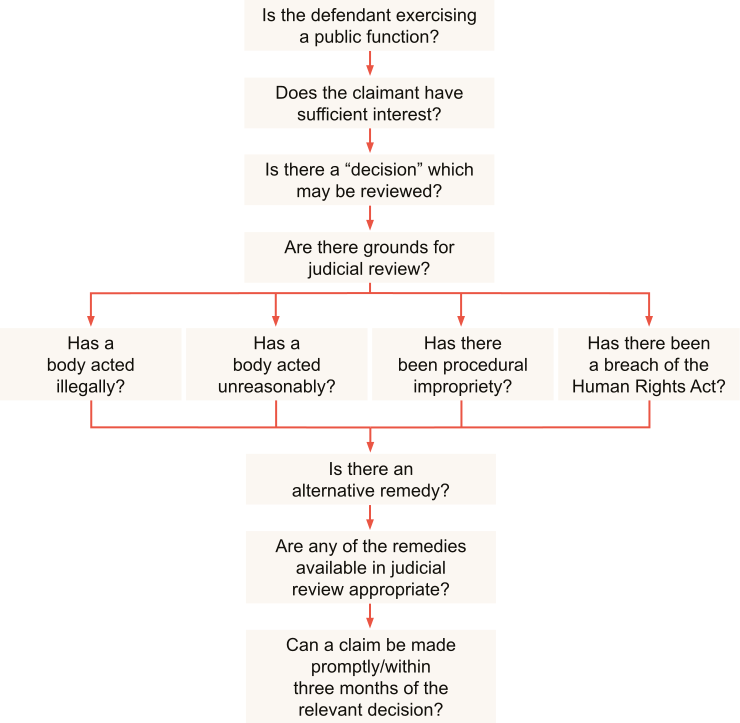
- CPR 54.1
- R v Advertising Standards Authority Ltd, ex parte the Insurance Service Plc [1990] 2 Admin LR 77.
- R v Panel on Takeovers and Mergers, ex parte Datafin plc [1987] QB 815.
- R v Football Association Ltd, ex parte Football League Ltd [1992] 2 All ER 833.
- ex parte Datafin plc.
- ex parte Football League Ltd.
- R (A) v Partnerships in Care Ltd [2002] EWHC 529 (Admin).
- R (Weaver) v London & Quadrant Housing Trust [2008] EWHC 1377 (Admin).
- R v Cobham Hall School, ex parte S [1998] ELR 39.
- R v Northumbrian Water Ltd, ex parte Newcastle and Tyneside Health Authority [1999] Env LR 715.
- R v Fairoaks Airport Ltd, ex parte Roads [1999] C.O.D. 168.
- Section 31(3) of the Senior Courts Act 1981.
- R v Secretary of State for Foreign Affairs, ex parte World Development Movement Ltd [1995] 1 All ER 611.
- R v Attorney General, ex parte ICI Plc [1987] 1 C.M.L.R. 72.
- Re Irwin's Application for Judicial Review [2017] NIQB 75.
- R (on the application of Hussain) v Secretary of State for Health and Social Care [2022] EWHC 82 (Admin)
- CPR 54.1.
- R v Legal Aid Board, ex parte Megarry [1994] C.O.D. 468.
- R (on the application of Easter) v Mid-Suffolk District Council, [2020] All ER (D) 19 (Nov).
- CPR 54.17.
- R v Central Criminal Court, ex parte Francis & Francis [1989] AC 346.
- Section 2 of the Judicial Review and Courts Act 2022 reversing the judgment in R (Cart) v The Upper Tribunal [2011] UKSC 28. A challenge can still be brought where the Upper Tribunal's decision not to grant an appeal gives rise to any question as to whether: (i) the Upper Tribunal had a valid application to appeal before it; (ii) the Upper Tribunal was properly constituted; (iii)
the Upper Tribunal acted in bad faith; and (iv) the Upper Tribunal's actions constitute fundamental breaches of the principles of natural justice (e.g. the decision was affected by bias or corruption). - R (RWE Npower Renewables Ltd) v Milton Keynes Council [2013] EWHC 751.
- R.(on the application of Trafford) v Blackpool BC [2014] P.T.S.R. 989.
- Carltona Ltd v Commissioner of Works and Others [1943] 2 All ER 560.
- R (on the application of King) v Secretary of State for Justice [2016] A.C. 384.
- Associated Provincial Picture Houses Ltd v Wednesbury Corporation [1948] 1 KB 223.
- Council of Civil Service Unions v Minister for the Civil Service [1985] AC 374.
- R (Johnson and others) v Secretary of State for Work and Pensions [2020] P.T.S.R. 1872
- Kanda v Government of Malaya [1962] AC 322.
- Magill v Porter [2001] UKHL 67.
- R (Ghadami) v Harlow District Council [2004] EWHC 1883 (Admin) [2005] LGR 24.
- AMEC Capital Projects Ltd v Whitefriars City Estates Ltd [2004] EWHC 393 (TCC).
- R (Buckinghamshire County Council and Others) v Secretary of State for Transport [2013] EWHC 481.
- North Range Shipping Ltd v Seatrans Shipping Corp [2002] EWCA Civ 405; [2002] 1 W.L.R. 2397.
- Council of Civil Service Unions.
- United Policyholders Group v Attorney General of Trinidad and Tobago [2016] 1 W.L.R. 3383.
- Luton Borough Council and others v Secretary of State for Education [2011] EWHC 217.
- Leigh v Commissioner of Police of the Metropolis [2022] 1 W.L.R. 3141.
- Section 31 Senior Courts Act 1981.
- The Judicial Review and Courts Act 2022 received Royal Assent on 28 April 2022, and the relevant provisions came into force on 14 July 2022(available here).
- Section 29A Senior Courts Act 1981- Explanatory Notes available here.
- Section 31 Senior Courts Act 1981.
- The general principles of a JRCCO are that: (a) the issues raised are in the public interest;(b) if the order is not made the applicant will probably discontinue the proceedings or cease to participate in the proceedings; and (c) it would be reasonable to do so.

